It seems that the books that are the most helpful for my prayer life are the ones that try to convey two main points: the simplicity of prayer and the necessity of prayer. I remember when I first came into the Church years ago I read a book by Father Sullivan entitled “How to be happy, how to be holy” in which he emphasized the absolute urgency of prayer for salvation while at the same time explaining

$12.95 with free shipping. Call Veritas today!
how anyone, anywhere, at any time can pray. Both the simplest souls to the greatest intellectuals can pray, and God judges our prayers not on their composition, but on their sincerity.
As it happens, though, I think we all need a reminder, from different perspectives, of those two basic truths about prayer; namely, prayer is fundamentally necessary for salvation and fundamentally accessible to everyone. As time goes on, Catholics who take their faith seriously can begin to experience a certain despondency in prayer for a number of reasons. Either they are going through a genuine dark night in their relationship with God, or they have lost their original purpose for praying, or they simply don’t “feel” like they are praying well or sufficiently. At times like these a gentle reminder of the true purpose of prayer is important.
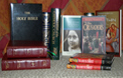
Father Jerome Bertram of the Oxford Oratory recently released a book entitled “Jesus, teach us to Pray” which has helped me reorient my prayer life back to God. The first twenty pages were particularly helpful because he dispels the two most common misconceptions concerning prayer that can creep into our pysche like parasites onto a host. The first misconception is that prayer is simply a means to get God to “do things”. It may seem that every Catholic should know better that God’s will can’t be made subject to our whims, but, like I said, when you have been praying for months or years for others and yourself, if you don’t take a minute to step back and reevaluate the true purpose of prayer, this mindset can sink in.
Father Bertram writes, “If we think of prayer as simply demanding things from God there are two immediate consequences. One is that it totally eliminates any idea of love, for how can you say you love someone if your entire conversation with them consists of relentless demands? The other is that it

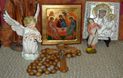
Angelus framed art. Customize with Veritas!
clearly doesn’t work. God does not immediately give us everything we demand, no matter how many times we demand it.”
Father says that when are demands are not met some people have recourse to “junk prayers” which are more or less superstitious petitions “with instructions that they must be recited in precisely the right tone of voice, the right number of times, on precisely the right days, facing the right direction.” This of course is absurd, but sometimes the best of us can fall into the trap of believing that are boring common prayers need a little Shakespearean tonality and composition to get God’s attention. That’s why we sometimes fixate on the “right” prayers to say from a prayerbook.
But thanks be to God, prayer is much more beautiful in God’s eyes when it comes from the heart, even if it is dull.
But Father Bertram also warns against the idea that we pray to “gain an inner experience”. Many have fallen into believing that we pray simply to better ourselves and to empty ourselves of negative “experiences.” But this too is not the essence of prayer.
The essence of pray is simply an expression of love. Love for God. We pray to tell God we love him.

$9.00 with free shipping. Call Veritas today!
We pray that we may love him more.
The rest of the book covers the legitimate use of intercessory prayer, vocal prayer, and meditative prayer with an emphasis on the maxim that we should always, “pray as we can, not as we can’t”. The emphasis should always be on the presence of God who knows what we need before we ask him. Thus we should not be so specific, according to Father Bertram, in our prayers that we lecture God into a definite response. Rather, we should be listening to God’s will. Our prayers should not sound like, “As you have read in today’s paper, O Lord, there has been another earthquake in China….Help us to put pressure on the government and the United Nations to provide relief for natural disasters.”
Rather our prayers should be simple and trusting, “O God, we pray for those suffering in China.”
The last half of the book is an exposition of the perfect prayer, the Lord’s prayer. I am glad that a priest was not afraid to write yet another book on prayer, especially one that makes just a few simple observations.
When it comes to prayer, it is precisely the obvious that needs to be most frequently emphasized, again and again.